You do not need to stop taking oral contraceptives on that day, and if you are taking any specific thyroid monitoring treatment, it is preferable to have the sample taken before taking the dose for that day.
94,99 € — or subscribe to save up to 10%
The female fertility test evaluates your ovarian reserve based on anti-mullerian hormone and analyses your thyroid function to identify possible hormonal causes that can make it difficult to get pregnant.
Having trouble getting pregnant? This fertility test, carried out at home, is designed for women who are having difficulty conceiving or who are considering assisted reproduction, and analyses key factors such as ovarian reserve and thyroid status.
THE FEMALE FERTILITY TEST IS FOR YOU IF...
139,99 € — or subscribe to save up to 10%
The female hormone test includes 2 kits to measure the relevant female hormones in two phases of the cycle: the follicular phase (between days 3-5 of the cycle) and the luteal phase (7-9 days before the next cycle). It allows to rule out ovarian dysfunctions such as PCOS, to understand ovulation and symptoms such as painful or irregular periods.
44,99 € — or subscribe to save up to 10%
Tiredness, weight or mood swings? Alterations in thyroid function can affect the balance of the body. With this test you can evaluate the main thyroid markers in the blood (free T4 and TSH, which regulates the gland) and identify possible alterations such as hypothyroidism and hyperthyroidism, without displacement.
74,99 € — or subscribe to save up to 10%
Anti-Müllerian hormone (AMH) is the most reliable marker of ovarian reserve. An anti-Müllerian test is especially recommended after the age of 35, if you are planning a pregnancy, are going to start assisted reproduction or simply want to know your current fertility.
94,99 € — or subscribe to save up to 10%
Having trouble getting pregnant? This fertility test, carried out at home, is designed for women who are having difficulty conceiving or who are considering assisted reproduction, and analyses key factors such as ovarian reserve and thyroid status.
Exposures, check-ups, new beginnings: find out if there is something wrong with you from home, without appointments, totally private and discreet.
Hospital laboratory standards
Get a check-up before a new relationship, without explanation
Screen for STIs (or STDs) at home with complete discretion and privacy
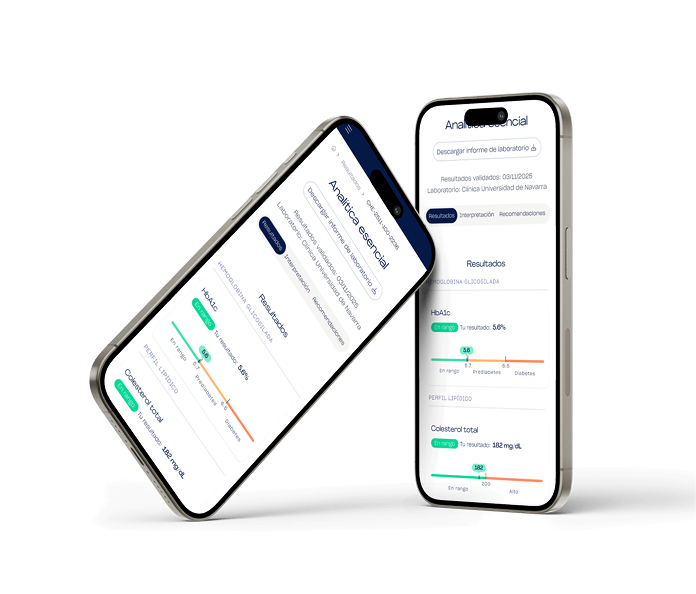
Results in 24-48h with medical interpretation included.
Medical interpretation included in all tests
You now have the option of scheduling a personal consultation:
Understand what your values mean
Ask questions if you don't understand
Decide your next steps with clarity and clinical rigour.
You do not need to stop taking oral contraceptives on that day, and if you are taking any specific thyroid monitoring treatment, it is preferable to have the sample taken before taking the dose for that day.
The thyroid is an endocrine gland that produces hormones important for regulating metabolism and cell growth. A malfunctioning thyroid can affect female fertility in several ways:
A woman is born with approximately 2,000,000 primary follicles. Thereafter, the ovary remains inactive until puberty, when about 300,000 remain, with about 1,000 dying each month during a woman's fertile years. After the age of 35, the chances of achieving a spontaneous pregnancy decrease significantly as the number of follicles drops drastically, as does the quality of the oocytes due to reproductive ageing, reaching the menopause with very low oestrogen levels.

Anti-Müllerian hormone (AMH), which is the hormone we use to estimate ovarian reserve, remains relatively stable throughout the hormonal cycle. Therefore, you can take the test at any time, without having to wait for a specific phase. However, recent studies have found that values may vary slightly (around 10 %) depending on the phase of the cycle: they are usually slightly higher in the early follicular phase (first days of the cycle) and slightly lower in the luteal phase. This difference does not usually change the interpretation of the results, but if you want maximum consistency - for example, to compare results over time - you may prefer to do it in the early days of the cycle. As for TSH, which tests thyroid function, it does not vary significantly throughout the cycle, so it can be measured at any time.
There is no single interval for all women. How often you should repeat a fertility test depends mainly on your age, your previous results and your clinical situation. If your AMH and TSH results are normal and there are no changes in your health, repeating the test every 12-18 months is a reasonable practice.
Medical guidelines advise that TSH should be below 2.5 mIU/L in the pre-pregnancy period to optimise the chances of conception and reduce early risks. It has also been shown that TSH values between 2.5 and 4 mIU/L do not necessarily delay pregnancy, although being below 2.5 mIU/L is still recommended.
139,99 € — or subscribe to save up to 10%
The female hormone test includes 2 kits to measure the relevant female hormones in two phases of the cycle: the follicular phase (between days 3-5 of the cycle) and the luteal phase (7-9 days before the next cycle). It allows to rule out ovarian dysfunctions such as PCOS, to understand ovulation and symptoms such as painful or irregular periods.
44,99 € — or subscribe to save up to 10%
Tiredness, weight or mood swings? Alterations in thyroid function can affect the balance of the body. With this test you can evaluate the main thyroid markers in the blood (free T4 and TSH, which regulates the gland) and identify possible alterations such as hypothyroidism and hyperthyroidism, without displacement.
74,99 € — or subscribe to save up to 10%
Anti-Müllerian hormone (AMH) is the most reliable marker of ovarian reserve. An anti-Müllerian test is especially recommended after the age of 35, if you are planning a pregnancy, are going to start assisted reproduction or simply want to know your current fertility.
94,99 € — or subscribe to save up to 10%
.