

139,99 € — or subscribe to save up to 10%
The female hormone cycle test helps you measure hormone levels throughout your menstrual cycle to understand your menstrual cycle comprehensively and understand irregularities, fertility or prepare for menopause.
The female hormone test includes 2 kits to measure the relevant female hormones in two phases of the cycle: the follicular phase (between days 3-5 of the cycle) and the luteal phase (7-9 days before the next cycle). It allows to rule out ovarian dysfunctions such as PCOS, to understand ovulation and symptoms such as painful or irregular periods.
THE FEMALE HORMONE AND MENSTRUAL CYCLE TEST IS FOR YOU IF...

94,99 € — or subscribe to save up to 10%
Having trouble getting pregnant? This fertility test, carried out at home, is designed for women who are having difficulty conceiving or who are considering assisted reproduction, and analyses key factors such as ovarian reserve and thyroid status.
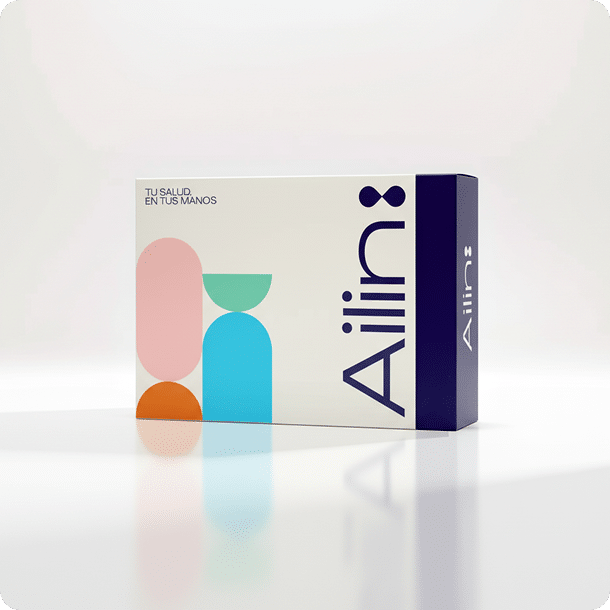
74,99 € — or subscribe to save up to 10%
Anti-Müllerian hormone (AMH) is the most reliable marker of ovarian reserve. An anti-Müllerian test is especially recommended after the age of 35, if you are planning a pregnancy, are going to start assisted reproduction or simply want to know your current fertility.
Throughout the menstrual cycle, female hormones fluctuate significantly to prepare the body for ovulation and possible pregnancy. The typical menstrual cycle lasts about 28 days, but can vary from 21 to 35 days in adult women. During this time, the hormones involved in the menstrual cycle, including estrogen, progesterone and luteinizing hormone (LH), undergo regular changes. Here is an overview of how female hormones fluctuate during the menstrual cycle:
For the correct measurement of our hormones throughout the cycle, we must understand that the sample must be taken at the right time for each hormone. This is because our female sex hormone levels fluctuate throughout the cycle. Therefore, for the measurement of prolactin, estradiol, LH and FSH, we should take our sample between days 3 and 5 of our menstrual cycle. Whereas, for progesterone measurement, you should take your sample 7 to 9 days before your next cycle.
Yes, you can take this test if you are pregnant. However, you should understand that your female sex hormone levels will naturally be altered with pregnancy and will move into other ranges, which we will consider when interpreting your results.
The first day of your menstrual cycle will be the day you start your period and will last until the first day of your next period, lasting about 21 to 35 days in adult women. Therefore, to take your two menstrual cycle tests, you should count the days from the first day you start your period.
The menstrual cycle monitoring test does not require any special preparation. However, you should be aware that the use of contraceptives or the use of drugs may affect the results of the test.
"For quick results"
"For convenience"
"Because it is very complete and I like the option of being able to do it from home when it suits you"."
"Because it goes beyond "everything is fine, within normal ranges". It refines within normality by offering answers to help you according to your objective."
"The process has been quite simple and convenient, and the results are coming quickly."
"On the one hand, because it is very convenient both for delivery and collection without having to queue or travel. On the other hand, the interpretation of the results by a professional is simple and understandable. The recommendations are clear and practical with the option to read more information about it, which is essential to broaden your knowledge."
"It is easy and straightforward to take the test"."
"I found the process very straightforward. Very attentive."
"For quick results"
"For convenience"
"Because it is very complete and I like the option of being able to do it from home when it suits you"."
"Because it goes beyond "everything is fine, within normal ranges". It refines within normality by offering answers to help you according to your objective."
"The process has been quite simple and convenient, and the results are coming quickly."
"On the one hand, because it is very convenient both for delivery and collection without having to queue or travel. On the other hand, the interpretation of the results by a professional is simple and understandable. The recommendations are clear and practical with the option to read more information about it, which is essential to broaden your knowledge."
"It is easy and straightforward to take the test"."
"I found the process very straightforward. Very attentive."
"For quick results"
"For convenience"
"Because it is very complete and I like the option of being able to do it from home when it suits you"."
"Because it goes beyond "everything is fine, within normal ranges". It refines within normality by offering answers to help you according to your objective."
"The process has been quite simple and convenient, and the results are coming quickly."
"On the one hand, because it is very convenient both for delivery and collection without having to queue or travel. On the other hand, the interpretation of the results by a professional is simple and understandable. The recommendations are clear and practical with the option to read more information about it, which is essential to broaden your knowledge."
"It is easy and straightforward to take the test"."
"I found the process very straightforward. Very attentive."
"For quick results"
"For convenience"
"Because it is very complete and I like the option of being able to do it from home when it suits you"."
"Because it goes beyond "everything is fine, within normal ranges". It refines within normality by offering answers to help you according to your objective."
"The process has been quite simple and convenient, and the results are coming quickly."
"On the one hand, because it is very convenient both for delivery and collection without having to queue or travel. On the other hand, the interpretation of the results by a professional is simple and understandable. The recommendations are clear and practical with the option to read more information about it, which is essential to broaden your knowledge."
"It is easy and straightforward to take the test"."
"I found the process very straightforward. Very attentive."
"For quick results"
"For convenience"
"Because it is very complete and I like the option of being able to do it from home when it suits you"."
"Because it goes beyond "everything is fine, within normal ranges". It refines within normality by offering answers to help you according to your objective."
"The process has been quite simple and convenient, and the results are coming quickly."
"On the one hand, because it is very convenient both for delivery and collection without having to queue or travel. On the other hand, the interpretation of the results by a professional is simple and understandable. The recommendations are clear and practical with the option to read more information about it, which is essential to broaden your knowledge."
"It is easy and straightforward to take the test"."
"I found the process very straightforward. Very attentive."
107,00 € El precio original era: 107,00 €.68,00 €El precio actual es: 68,00 €.
92,00 € El precio original era: 92,00 €.59,00 €El precio actual es: 59,00 €.
92,00 € El precio original era: 92,00 €.59,00 €El precio actual es: 59,00 €.
139,99 € — or subscribe to save up to 10%
.